
 Posted by
 There is no doubt why Buddhist statues are considered the most peaceful forms of sacred art even today. Just a glance at a Buddha statue, and you can feel a sudden calmness and realize the inner awareness. The life teachings of Mahatma Buddha are truly inspiring, like how he renounced all the luxuries and become monk in search of truth.
Even after the Mahaparinirvana, his teachings continued to travel beyond the Indian subcontinent. As a result, the followers of Buddhism outside India needed the celestial persona of Buddha to visualize his form. Thus, Buddhism started creating a category of artwork depicting Gautama Buddha in different stages of his life.
These artworks were inspired by the characteristics of the Buddha and his teachings, with each having a spiritual meaning behind it. So, let us today introduce the 10 popular Buddha statues around the world and the spiritual meaning behind each of them.
Different Types of Buddha Statues Around the World
If you travel the world, especially around Asia, you are sure to find a unique Buddha statue specific to that region. The statues in Thailand, Japan, or China often look very different from a traditional Indian marble Buddha murti.
Here are some of the most popular statues of Buddha around the world:
Meditating Buddha
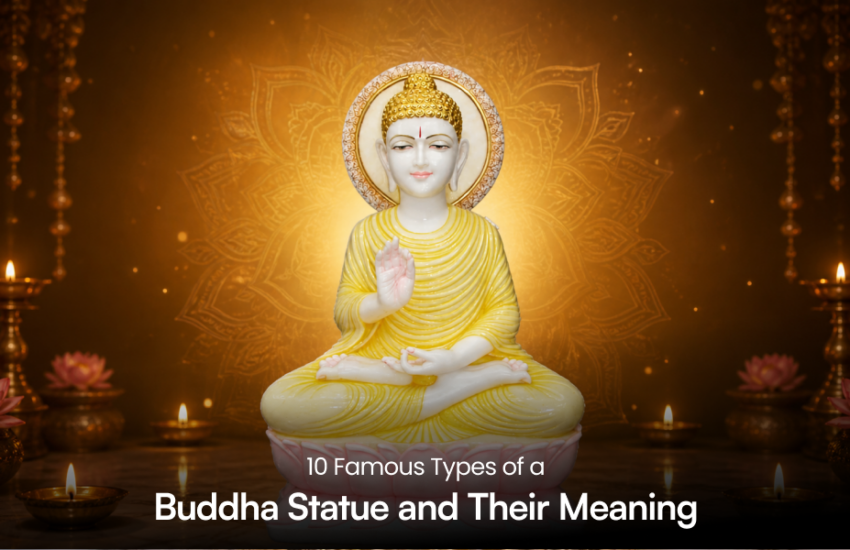
The meditating Buddha statue is one of the most common forms of Buddhist art. The posture depicts Mahatma in deep meditation, seated in full lotus position. Both of his soles are upward and resting on opposite thighs.
In this idol, both of his hands are in dhyana mudra, with the right hand resting on top of the left and the thumbs touching. This posture means the balance and concentration to invoke the inner awareness.
The depiction of the Buddha murti can be seen as sitting under a Bodhi tree or over a lotus pedestal. A meditating Buddha statue for home is said to bring calmness and peace within the environment. Moreover, a statue of a meditating Buddha is suitable for welcoming areas and house gardens.
Seated Buddha
The seated Buddha statue represents the state when mahatma had attained enlightenment through his dhyana (meditation). The idol is often depicted as the Buddha in bhumisparsha mudra, which means earth-touching gesture. His one hand is on his lap, but the other is reaching towards the ground.
The long earlobes of Mahatma Budh highlight his early life as a prince, when he used to wear ornate earrings that stretched his ears. However, in pursuit of enlightenment, he renounced his royal status, but his stretched earlobes continue to represent spiritual renunciation and the ability to hear the suffering of the world. Keeping a seated Buddha idol in the garden area attracts prosperity in the house.
Reclining Buddha
While most of us consider the reclining position as rest, Buddha’s reclining statue depicts something different.In fact, it shows the final moments of his passing into Parinirvana. The posture is also known as the Lion posture in some Asian regions, showcasing Buddha lying on his right side, resting on his hand as a pillow.
The statue depicts death as the fulfillment of the spiritual path, instead of an end. Therefore, the expressions of Buddha in this statue are calm and composed, telling a lot about detachment at the moment of release. In some cases, in some Asian regions, the statue also showcases his disciples gathered around in grief.
Medicine Buddha
The Medicine Buddha statue, also popularly known as Bhaiṣajyaguru, has healing aspects using the medicine of his life teaching. The statue depicts Buddha in a seated position (varada mudra) with a calm gaze.
His right hand is downward over his knee in a gesture of offering, or sometimes holding a myrobalan fruit, an ancient plant with medicinal properties. Meanwhile, his left hand is resting on his lap with a bowl containing medicinal ointment.
The medicine Buddha idols are often depicted in a deep blue color, which is a symbol of the color of lapis lazuli. Furthermore, in Tibetan culture, he is depicted with six accompanying monks, known collectively as the Seven Medicine Buddha statue.
Standing Buddha
Traditionally, the standing Buddha statue represents the highest point in sacred art. The entire body of Buddha is covered in monastic robes, which makes a perfect balance between movement and stability.
A standing Buddha statue is often installed in garden spaces or welcoming areas, symbolizing blessings, protection, and guidance. Thus, it represents the Buddha’s journey from his palace in Bodh Gaya to places he went to find the middle path.
Crowned Buddha Statues
The crowned Buddha idol represents Sambhogakaya or the body of enjoyment. It is the Nepalese representations of Buddha adorned with royal ornaments and brocaded clothes. The statue underlines Buddha as Chakravartin, or supreme ruler, because of his enlightened mind.
Crowned Buddha statues are aesthetically appealing, making them a favorite of both Buddhist followers and art collectors across the world.
Jizo Bodhisattva (Ksitigarbha)
The Jizo statue of Mahatma Buddha is particularly revered in Japanese culture. In Sanskrit, it means Ksitigarbha, one of the four principal bodhisattvas of Buddhism. He is regarded as the protector of children, travelers, and souls in different transitions.
Jizo Bodhisattva is often portrayed as a monk figure with a shaven head and holding a Shakujo in one hand and a wish jewel in the other. The Shakujo is used symbolically as the opener of hell gates, while the jewels are for helping all beings.
You can often see small Jizo statues at roadside shrines and cemeteries in Japan. People often offer them small offerings and dress them in red bibs.
Manjushri
Manjushri is one of the four bodhisattvas, along with Ksitigarbha. The Manushri statue of Buddha is worshipped across Mahayana and Tibetan culture. Buddha is often depicted sitting on a lion throne or a lotus.
Unlike other Buddha murtis, the Manjushri statue holds a flaming sword in the right hand and a sutra book in the left hand, resting on the top of a lotus flower.
Statues of Manjushri are often solitary or in a triad with other bodhisattvas. The meaning behind this Buddha statue is intellectual clarity and the courage to speak the truth without fear.
Kuan Yin (Guanyin)
Kuan Yin is considered the bodhisattva of compassion. It is also known as Guanyin, which is a Chinese form of Avalokiteśvara. In East Asia, it is mostly depicted in female form.
The Kuan Yin statue may depict her in both seated and standing positions, holding a willow branch and a vase full of nectar. Her facial expressions are composed and calm, with her right hand raised in abhaya mudra.
Kuan Yin statues are often highly ornate, yet they convey the teachings of attentive presence. She is a common Buddhist figure in and around Chinese temples and homes. Some art scholars even compare depictions of Kuan Yin with the Virgin Mary in Christian traditions.
Laughing Buddha (Hotei)
The Laughing Buddha statue is most common in Asian and Western regions. It is considered the best for home decor. Although it is often included among Buddhist figures, it is actually a Chinese folklore monk, who is often associated with Maitreya, the future Buddha.
The laughing Buddha statue is portrayed with a large belly, a laughing face, and a cloth sack over his shoulder. He usually stands in a relaxed posture, holding prayer beads or a fan. He is said to bring joy and abundance to the home.
Unlike other Buddha moortis, Hotei is more humorous and animated, and his presence is believed to ease tensions and lift spirits.
What are the Spiritual Benefits of the Gautam Buddha Statue for Home?
A Buddha statue is commonly seen in houses, gardens, offices, malls, and even outside premium spa centers. That clearly means there is something spiritually connected to the presence of Buddha that goes beyond décor or aesthetics.
- Calmness & Clarity: A Buddha statue is often associated with calmness and clarity of thought. Every time you look at the idol, you can feel a positive aura around you that calms your restless mind and makes you focus better on your inner thoughts.
- Inner Peace: The world is moving too fast, and everyone is racing to win something. However, this competitiveness has taken away the inner peace from human lives. But as per the teachings of Buddha, true peace comes from within. A Gautama Buddha statue conveys a message of slowing down and letting go of unnecessary stress.
- Mindfulness: The life teachings of Buddha suggest living in the present. Keeping a Buddha murti at home reminds people to stay mindful about their present actions, thoughts, and emotions, without being influenced by the past or future.
- Emotional Stability: The calm expressions of Buddha signify controlled emotions and mental balance. It is believed that a Buddha moorti helps disciples in regulating emotions, and reducing anger and stress.
- Positive Energy: A Buddha statue is a source of positive energy, and when it is placed respectfully, it is said to bring spiritual energy into the home. It creates a harmonious environment filled with positivity and peace.
Conclusion
The association of the Buddha statue with calmness, peace, and self-awareness is not hearsay but a reality many people have experienced. The teachings of Mahatma Buddha continue to inspire communities, and his statues around the world quietly spread the message.
If you are inspired by the teachings of Mahatma Buddha and want to bring these values into your life, keeping a Buddha statue can be the best decision. If you are looking for a marble Buddha idol online, there is no better place than Pandey Moorti Bhandar to order from. We have four generations of experience in manufacturing marble moortis and count among the best marble moorti manufacturers in India.
FAQs
Is It Good to Keep Gautama Buddha Statue at Home?
Yes, a Buddha statue is considered good luck for homes as it brings abundance, positivity, and emotional stability to the space. It is commonly placed in the Pooja room, the welcoming area, or the garden.
Which Buddha Statue is Good for Home?
A seated or meditating Buddha murti is said to be good for home installations. At the same time, standing Buddha statues can also be installed in garden areas.
Where Should I Put My Buddha Statue at Home?
You can place a Buddha idol in your home temple or a welcoming area. Meanwhile, Buddha statues for gardens are quite popular these days.
Does a Buddha Statue Bring Good Luck?
Yes, Buddha murti is said to bring good luck and abundance to the home. Especially the laughing Buddha statues, in Chinese culture, are said to bring good luck and financial stability.
Which Side Should a Buddha Statue Face?
A Buddha statue should face in the northeast direction as it is considered auspicious. Avoid placing it near bathrooms, in bedrooms, or directly on the floor.
How to Choose a Buddha Statue?
If you are ordering a custom Buddha statue, it is necessary to keep in mind a few things. Ensure that it is made of high-quality material, especially marble. Avoid buying marble dust idols, as they are not as pious and positive as marble. Choose the size according to your placement area. At last, choose the posture and expressions of the statue carefully.