
 Posted by
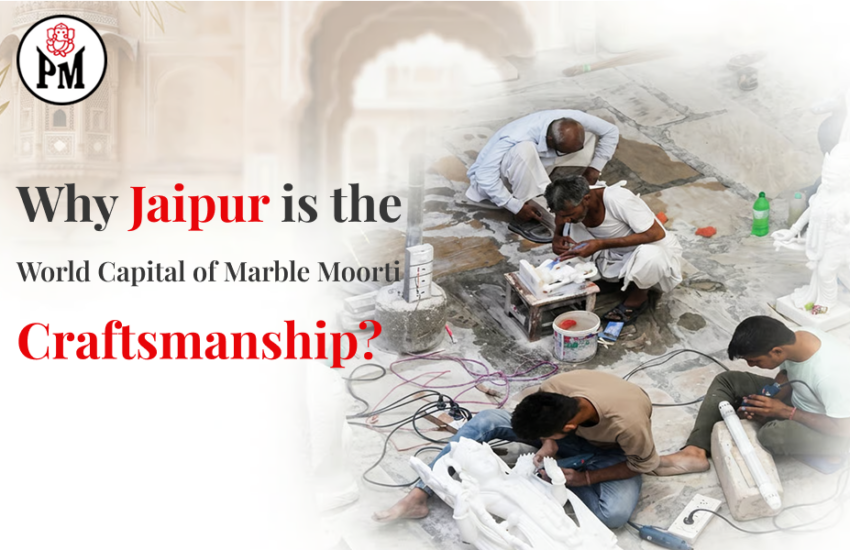
 Walk through the old city area of Jaipur on any ordinary afternoon. And there is one thing that is impossible to ignore, i.e., the constant whispering of hammer and chisel that never stops; that’s the story of Jaipur’s iconic moorti market. The artisans’ arts and skills that turn a simple marble block into divine idols and sculptures have earned the city the title of the world capital of marble murti-making craftsmanship.
Rajasthan and its connection with traditional art have existed for centuries, from folk music and miniature paintings to pottery and stone carving. Yet among these art forms, marble moorti making remains the specialty of the region. So, what makes Rajasthan, especially Jaipur, the epitome of art and the land of artisans?
Through this write-up, renowned sculptor and artist Prashant Pandey will share the untold story behind Jaipur’s rise as the world capital of marble murti craftsmanship and the traditions and artistic legacy that continue to keep this heritage alive even in these modern times.
How did Jaipur become the Centre of Marble Murti Making?
Jaipur’s connection with stonework is not limited to decorative art alone. The region holds a centuries-old tradition of idol making, temple building and marble handicraft work. Over time, marble murti making has strongly emerged as one of the strongest identities of the city. And the most prominent reason remains the support for the art in every way.
The artisans’ families have been settled here for generations, and it doesn’t take much effort to source the best quality of marble. Both Makrana and Baislana marbles are considered the best for idol making, and they are extensively available to Jaipur’s nearby districts. Another prominent reason is that temple traditions continue to remain deeply alive even today, which has earned Jaipur the name Choti Kashi.
Meanwhile, traditional continuity also contributed a lot to keeping the marble moorti-making art alive. In many places, traditional crafts are being reduced with changing times. But in Jaipur, the art and knowledge stayed inside families and workshops. Children learn by watching their elders work and spend years to finally become a skilled moortikar.
Is It the Craftsmanship or the Marble that Made Jaipur Famous?
Well! There is no one-sided answer, as it is both the quality of the stone and the artisans’ skills that work together to earn Jaipur a place among the most respected centres of Marble Murti craftsmanship.
Many of the artisans’ families are native to the city and have been in moorti making for 5-6 generations, even longer. In many traditional workshops, we see that the work still follows a discipline and tradition learned through family practices and shilp shastra.
At the same time, the quality of the stone plays a major role in complementing the craftsmanship. As mentioned earlier, Makrana and Baislana marbles are considered the highest quality of stones for carving idols.
Makrana marble is sourced from Makrana city in Rajasthan’s Didwana-Kuchaman district and is known for its clean look, natural brightness and durability. The marble is usually used for carving Ram Darbar statue, Radha Krishna murti, Shiv Parivar idol, Durga Mata statue, Ganesh moortis, and Jain idols. It is the same stone that was used to construct the Taj Mahal.
The second most used stone in Jaipur marble murti work is Baislana marble, which is sourced from the Bhainslana region in Kotputli district of Rajasthan. The stone has a smooth carving quality and deep black appearance, ideal for carving black stone deity forms, especially ISKCON-style Radha Krishna statues and Khatu Shyam idols.
A good murti isn’t carved from marble alone, and the craftsmanship alone cannot achieve the desired result without the right stone. Therefore, it is both marble and the craftsmanship of skilled artisans that gave Jaipur the recognition and identity it holds today.
What Makes Jaipur’s Marble Murti Craft Different from Other Cities?
Many cities in India create stone idols, but Jaipur has created a whole identity around them. The artistic freedom, traditional discipline, and availability of resources are the reasons behind this recognition.
Visual beauty is not the only consideration while carving a deity’s murti. Local Jaipur sculptors strictly follow shilp shastra principles to study posture, facial expressions, ornaments, hand positions, and proportions before beginning work. Even the design marking stage itself takes considerable attention, as a minor change in expression can completely change the idol’s look.
At the same time, Jaipur-based marble moorti manufacturers prefer handwork over modern machinery. Although modern machines are present in many places, they are usually for rough cutting. The fine detailing and intricate carving of eyes, fingers, jewellery patterns, lotus bases, crown detailing, and clothing folds are still completed with hands that carry years of experience.
Meanwhile, marble murti manufacturers in Jaipur are known for their custom work. They are skilled at crafting small home murtis, large temple installations, deity’s standing & seated forms, traditional styles, regional interpretations, and temple-specific designs.
Why Do Temples and Devotees Choose Marble Murtis Made in Jaipur?
The selection for temple murtis is usually based on longevity. And marble remains one of the most preferred materials for idol making, as it is highly durable and carries a calm aura suitable for such sacred spaces. Many Hindu temples across the world prefer handmade murtis because even minor details matter in worship traditions. The posture, expressions and balance are carefully observed during selection. Jaipur’s popularity has grown because of its consistency in maintaining these details and preserving traditional carving practices.
At the same time, temples often need custom-sized idols and follow distinct traditional styles based on regional practices and temple architecture. Jaipur-based sculptors have experience in crafting custom deity forms, aligned with accepted temple styles.
How are Jaipur’s Artisans Maintaining this Legacy in Modern Times?
The biggest challenge for traditional art to survive in this modern world is not the availability of tools, but continuity. However, many legacy workshops have adapted according to changing needs while preserving the traditional handcrafting practices. Digital communication, online catalogues and wider delivery networks have helped Jaipur-based sculptors reach people outside Rajasthan and India as well.
Despite this adaptation, the actual carving process remains deeply traditional, and several family-run workshops continue to train younger generations to learn the divine art of God Idol making.
Among such continuing family traditions, Pandey Moorti Bhandar is such a perfect example of marble craftsmanship that has been carefully carried forward across four generations, preserving traditional techniques while continuing the legacy of handcrafted murti making.
A special milestone for them came with the blessing of contributing to the prestigious Ram Mandir in Ayodhya. The workshop was entrusted with crafting more than 30 idols for the temple premises, including a white marble Ram Lalla and Ram Darbar installed on the first-floor of the temple.
Conclusion
Jaipur did not become known for marble murti craftsmanship in a day or overnight. Its popularity grew over time, through generations of skilled handwork, favourable conditions, sacred temple traditions and workshops that stuck to their values even when modern art is taking over.
Every god idol carries years of experience, precision, understanding, respect and detailing that help present the deity in a form that feels true to its sacred identity. This is why Jaipur continues to be the strongest name in this craft.
As long as artisan families like Pandey Moorti Bhandar continue to treat marble murti making as a tradition rather than a business, the sound of hammer and chisel will continue to be heard for many years ahead.
FAQs
Which Marble is Commonly Used for Making Marble Murtis in Jaipur?
Markrana marble and Baislana marble are among the most preferred and commonly used stones for making Hindu God idols in Jaipur. While Makrana marble is widely used for white deity forms, Baislana marble is commonly preferred for black stone idols.
Are Jaipur Marble Murtis Handmade or Machine-made?
Most of the Jaipur-based marble moorti-making workshops primarily use hand-carving techniques to carve intricate details, facial work, and ornamental patterns. However, they often use machines for rough stone cutting.
How Long Does It Take to Make a Marble Murti?
There is no fixed time slot for making marble murtis, as it greatly depends on the size and the detailing. While small God idols for the home may take several days, temple-scale work can continue for weeks or even months.
Can Jaipur Marble Murtis be Customized?
Yes, Jaipur-based workshops are known for their custom marble moorti-making abilities. They can customize the idols according to dimensions, deity forms, posture styles, finishing details, and temple-specific requirements.
How can Buyers Identify an Original Marble Murti?
To evaluate the originality of the marble murti, look for stone quality, carving sharpness, facial balance, smooth finishing, proportion consistency, and workshop credibility.