
 Posted by
 The joy of celebrating Navratri in India is on a different level. In fact, it is the time of year people keep waiting for. The streets are decorated with bright, colourful lights; there are pandals all around, and the entire atmosphere feels deeply devotional. But have you ever wondered what makes Navratri so special? What is the significance behind these celebrations?
Navratri have long been a part of Indian culture and has been celebrated for generations. While the new generation is enthusiastic about celebrating the festivals, many rarely know the stories and beliefs behind them. And there is a fascinating story behind Navratri that makes the celebrations even more meaningful and special.
Today, renowned marble sculptor Satya Narain Pandey, known for his knowledge of Hindu Puranas and Indian traditions, helps us understand the deeper meaning of Navratri, the nine forms of Maa Durga, and why this festival continues to be so important in Hinduism.
Why is Navratri Celebrated?
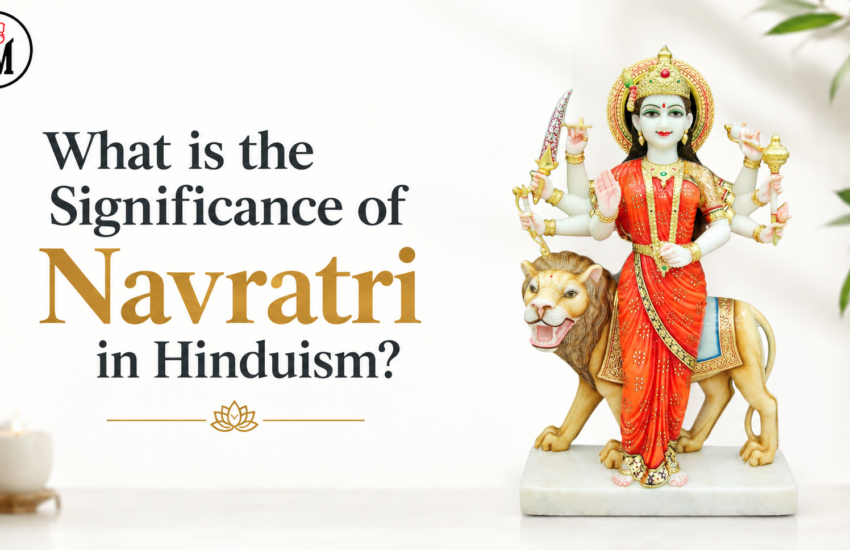
Navratri is celebrated to honour Mata Durga and the divine feminine power known as Shakti in Hindu tradition. The term “Navratri” is derived from two Sanskrit words, “Nava,” which means nine and “Ratri,” which means night. As its name suggests, the festival is observed over nine nights, usually followed by a celebration on the tenth day.
There is a fascinating story behind why Navratri is celebrated. The story associated with Sharad Navratri highlights the battle between Goddess Durga and Mahishasura, a powerful demon king with a special immortal boon from Lord Brahma.
With the belief that no one could defeat him, Mahishasura became arrogant and expelled the gods (Devas) from heaven. Seeing the powerlessness of the Devas against the demon, Lord Brahma, Vishnu, and Shiva channelled their collective rage and divine energies to manifest Maa Durga. Every God gave Mata Durga a powerful weapon, including a trident (Trishul) from Lord Shiva and a chakra (discus) from Lord Vishnu. The Goddess fought the demon, and the battle continued for nine days until Maa Durga eventually defeated Mahishasura on the tenth day, known as Vijayadashami or Dussehra. That is the reason why Mata Durga is often known by the name “Mahishasura Mardini.”
The victory represents the triumph of good over evil and restoration of Dharma (righteousness). Apart from the battle, the nine days of Navratri are also associated with nine forms of Maa Durga, together known as Navadurga.
Significance of the Nine Forms of Goddess Durga
The nine forms of Mata Durga are traditionally worshipped one after another during the nine days of Navratri. Here’s the significance behind every form of Navratri Goddess Durga:
1. Shailputri
Maa Shailputri is worshipped on the first day of Navratri. Her name translates to “daughter of the mountain,” which refers to her traditional connection with Raja Himavan.
She is usually depicted riding a bull and carrying a lotus and a trident. Mata Shailputri is believed to bless devotees with stability and strength.
2. Brahmacharini
The second day is devoted to Maa Brahmacharini. Her story is associated with Goddess Parvati’s severe penance and determination to attain Lord Shiva as her husband.
She is generally shown standing barefoot, carrying a water pot and rosary. Unlike other forms of Maa Durga, her appearance is quiet and restrained. Her association with devotion, patience and determination blesses devotees with disciplined strength but not fierceness.
3. Chandraghanta
Chandraghanta Mata is worshipped on the third day of Navratri. The name resembles the crescent-shaped moon traditionally shown on her forehead. The form is more martial than the first two. Her ride on a Tiger with weapons in both hands connects the form with courage and readiness to confront danger or wrongdoing.
However, it is wrong to associate Maa Chandraghanta with fear. Rather, this form of Mata Durga resembles the courage required when a difficult situation is hard to ignore.
4. Kushmanda
On the fourth day of Navratri, devotees traditionally worship Maa Kushmanda. The name of this form is connected with the creation of the universe. In traditional understandings, she is associated with the cosmic energies that bring life into existence.
Maa Chandraghanta is often shown with eight arms and is also known by the name “Ashtabhuja Devi.” She reminds devotees that Shakti is not only a force to destroy evil but should be understood as energy through which life and creation are sustained.
5. Skandamata
The fifth day of Navratri belongs to Skandamata, the mother of Skanda (Lord Kartikeya). She is traditionally depicted as holding her young son, seated on a lotus. The form is associated with the strength of motherhood, reminding devotees of a mother’s love, patience, responsibility, and protective nature.
This is one of the gentler forms of the Navadurga tradition. Her presence is proof that Shakti can also be expressed through care and love.
6. Katyayani
Katyayani Mata is worshipped on the sixth day of Navratri. Many traditional texts associate Her connection with the sage Katyayana. She is strongly associated with the warrior aspect of Mata Durga.
Her connection with the battle with Mahishasura makes her particularly important when discussing the Goddess’s role in confronting evil and wrongdoing. The form inspires the devotees that patience is not enough sometimes, and a person needs to take a firm stand.
7. Kalaratri
The seventh day of Navratri is associated with Maa Kalaratri, which is the fiercest form of Goddess Durga. She is traditionally depicted with a dark complexion, loose hair and a fierce look.
Her appearance may look a little frightening, but this fierceness has a purpose. Kalaratri represents the force that confronts darkness and destructive forces. However, this does not mean that worshipping this form of Durga guarantees protection from every danger in ordinary life. The significance is that instead of running from difficulties, one should face them with courage.
8. Mahagauri
On the eighth day, Mahagauri Mata is worshipped with great joy. Her name is associated with great purity and brightness, and she is traditionally depicted as a calm and peaceful form of Navadurga.
Her looks are noticeably contrasted with Kalaratri. After one of the fiercest forms of the Goddess, there is a form more associated with purity, serenity and calmness. Her place towards the end of Navaratri gives the festival a quieter character before the final day.
9. Siddhidatri
The ninth and final day of Navratri belongs to Mata Siddhidatri. Her name is associated with Siddhis, which means spiritual accomplishments in Hindu traditions. She is commonly depicted sitting on a lotus and carrying traditional attributes of the Goddess.
As the final form of Navadurga, Siddhidatri is often believed to bless devotees with fulfillment and spiritual accomplishments. After the nine days, the final day brings together all the different qualities represented during Navratri.
Why is Navratri Important in Hinduism?
Navratri has many meanings, from traditional religious stories and the worship of Shakti to devotional discipline and the shared customs that bring families together.
1. Victory of Good Over Evil
The traditional story of Maa Durga defeating Mahishasura is the main message behind the festival’s moral meaning. Mahishasura represents destructive powers, while Durga’s victory over him presents the restoration of Dharma (righteousness).
For devotees, it shares a message that wrongdoing can never overpower righteousness. Navaratri remembers the triumph through worship of nine different forms of Maa Durga.
2. Celebration of Shakti
Shakti means divine power or energy, and Navratri gives particular importance to its feminine expression through Goddess Durga. This is special because Maa Durga is not shown in one role.
She can be a daughter, a mother, a devotee, a creator and a warrior. Through these different forms, Hindu traditions present feminine power as capable of creation, protection and confrontation.
3. Promotes Self-Discipline
For many families, Navratri changes the rhythm to be more festive than ordinary days. People wake up early for worship, avoid tamsik bhojan, observe a fast and spend more time in the temple.
The value of these practices is primarily devotional. It is a way of practicing self-discipline and keeping one’s attention on the purpose of the festival.
4. Builds Inner Strength
The nine forms of Maa Durga inspire devotees to embrace different qualities. Shailputri brings steadiness, Brahmacharini reflects commitment, Chandraghanta brings courage, Skandamata reminds us of care, and Mahagauri offers an image of calmness.
The point is not to expect that these qualities will magically be received through worship. Rather, the different forms encourage devotees to reflect on these values and bring them into their own lives through their thoughts, actions, and conduct.
5. Brings Communities Together
Navratri is a festival that is not celebrated behind closed doors. In many states, such as Gujarat and Maharashtra, there are large community gatherings for Garba and Dandiya. In Bengal, people gather together in neighbourhoods to celebrate Durga Puja. And in many parts of North India, families perform Kanya Puja, while South indian households may arrange Golu displays.
Despite the different cultures and customs, true devotees always find ways to celebrate. Families cook, pray and prepare together, bringing communities closer.
Conclusion
So, after reading this blog, we are sure that the next time someone asks you why Navratri is celebrated, you already know the answer. The festival honours Goddess Durga and her nine divine forms. For many families, it is the time for prayers, self-discipline, fasting, and celebrating with communities. While customs may differ from region to region, devotion remains an important part of the festival.
For families wishing to bring this devotion into their homes through traditional marble idols, Pandey Moorti Bhandar is a name worth considering. With over 4 generations of experience, we specialize in Maa Durga murti for Navratri. As an experienced marble murti manufacturer in India, we continue to follow the detailing and artistic traditions that give each murti its distinct devotional character.
FAQs
What Does Navratri Symbolize?
Navratri traditionally symbolizes faithful devotion towards Goddess Durga, the divine feminine power of Shakti and the victory of good over evil. The nine days of Navratri offer devotees an opportunity for prayer, self-discipline and embracing different values &qualities.
What is the Difference Between Navratri and Durga Puja?
Navratri is a nine-night festival associated with worshipping the nine different forms of Maa Durga. Meanwhile, Durga Puja specifically celebrates Goddess Durga and is particularly prominent in Bengal and Eastern India.
What is the Story Behind Navratri?
The traditional story behind Navratri is the victory of Goddess Durga over the demon king Mahishasura. Maa Durga fought with Mahishasura for nine days and defeated him on the tenth day, representing the triumph of good over evil and restoration of Dharma (righteousness).
Why do People Fast During Navratri?
Many devotees fast to express their devotion and personal discipline towards the deity. While some avoid particular food, others follow different fasting practices or do not fast at all. It all depends on individual circumstances, family traditions and regional beliefs.
What is the Significance of Kanya Puja During Navratri?
Kanya Pujan is a traditional practice often performed in North India during Navratri in which young girls are honoured as expressions of the Goddess. It usually takes place on the eighth or ninth day of Navratri. It includes prayers, food, and gifts for girls.