
 Posted by
 Navratri is undoubtedly one of the most prominent Indian festivals, with streets being decorated with colourful lights, celebrations everywhere you see and the joyful spirit of devotees. Especially for the Bengali community, it is the time they have waited for the entire year to celebrate Durga Puja with enthusiasm and devotion.
As you visit different Durga Puja pandals, you might have probably noticed something interesting. Along with the idol of Goddess Durga, four other deities are also traditionally worshipped together. But if it’s a festival dedicated to Goddess Durga, why are these other deities a part of the celebration? And what does each of them represent?
Through this article, renowned marble sculptor Prashant Pandey shares his knowledge to uncover the significance behind the five main deities worshipped during Durga Puja and why they are worshipped together.
Understanding the Importance of Durga Puja
Durga Puja is celebrated to honour the victory of Maa Durga over the demon king Mahishasura. Armed with his powers, Mahishasura built a large demon army and attacked many Devas to take control of Earth, Heaven and the Netherworld.
With Lord Brahma’s boon to never be defeated by any male, Mahishasura felt completely safe, thinking no woman would dare to even touch Him. According to the Puranas and ancient texts, the male gods (Brahma, Vishnu, and Shiva) came together, and their combined divine powers invoked Maa Durga.
Goddess Durga rode on a lion to challenge the demon. She then fought Mahishasura, and the battle continued for nine full days and nights. On the tenth day, Mata Durga defeated him and pierced him with her trident, which earned her the title “Mahishasuramardini.”
For devotees, Durga Puja is a time to seek the blessings of Maa Durga for protection, strength and courage. The festival also brings families together, giving them an opportunity to worship and meet relatives.
The celebration has a particularly special place in the Bengali community. In West Bengal and many Bengali communities in different parts of the world, Durga Puja is one of the most important and eagerly awaited festivals of the year. In traditional Bengali culture, Maa Durga comes to her Maternal home with her children, Lakshmi, Saraswati, Ganesha and Kartikeya.
Durga Puja is often related to Navratri, as both festivals are dedicated to the worship of Maa Durga and her different forms. However, customs and traditions are different across regions and cultures. But Bengali Durga Puja has its own traditions, rituals and distinctive idol arrangement.
What are the 5 Idols in a Durga Puja Pandal?
If you walk into any traditional Durga Puja pandal, you are sure to find the statue of Maa Durga as the central figure, accompanied by the idols of Goddess Lakshmi, Maa Saraswati, Lord Ganesha and Lord Kartikeya.
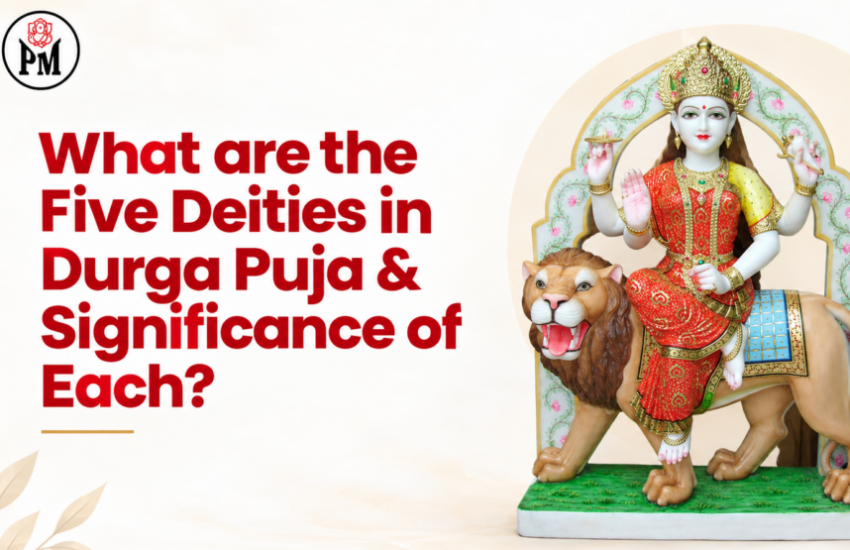
Mata Durga Statue
Maa Durga is the main focus of the entire Durga Puja arrangements. She is traditionally associated with protection, strength and the victory of good over evil. Her divine form is the first thing devotees notice when they enter a pandal. The expressions on the face, the proportion of hands and the overall ornamentation of Durga Murti all contribute to how devotees see the idol.
From a sculptor’s point of view, these details are something that matters a lot. The face of the idol should look balanced, as even a minor difference in expression can change the entire character of the murti.
The statue of Maa Durga is usually made from different materials and styles. Both temporary festival idols and permanent marble idols have different requirements. For instance, a marble Durga idol is generally made for long-term use and detailed finishing in mind.
Goddess Lakshmi Idol
The presence of a Goddess Laxmi statue behind Maa Durga adds another important aspect to the entire arrangement. In Hindu traditions, Mata Laxmi is associated with prosperity, abundance and wisdom. While many people associate Her with money, Her significance does not have to be understood only in terms of finances.
The blessings of prosperity are usually connected with stability, well-being and the ability to take right decisions. This is why the Lakshmi idol, alongside Maa Durga, completes the family arrangements. Her presence brings well-being into a setting.
Maa Saraswati Murti
Maa Saraswati brings yet another important aspect to the arrangement. She is considered the goddess of learning, knowledge, wisdom, music and the arts. Her presence in Durga Pooja reminds devotees that the knowledge and wisdom in life are as important as strength.
The detailing around the Saraswati murti is often delicate, particularly around the face, hands and musical symbols. When several idols are made together, their proportions must complement one another so that one figure does not look out of place beside another.
Lord Ganesha Statue
Lord Ganesha has been traditionally associated with auspicious beginnings and the removal of obstacles. His presence in Durga Puja idol sets has a familiar significance for devotees. Major religious occasions, including Durga Puja, start with prayers seeking auspiciousness and the smooth completion of the work being undertaken. And the inclusion of Lord Ganesha murti alongside Maa Durga naturally fits into that understanding.
His distinctive form also adds a different visual character to the arrangement. The expressions on the face, the shape of the trunk, hands and ornaments all need special attention during the carving process.
Lord Kartikeya Idol
Lord Kartikeya, the son of Lord Shiva and Goddess Parvati, is the fifth deity traditionally seen in the Durga Puja idol arrangement. In Hindu beliefs, he is associated with courage, strength and warrior qualities.
His presence completes the family setting. Unlike looking at each idol separately, the complete arrangement helps devotees to view deities together as members of one divine family.
For an artisan, making these figures as a set requires attention to detail. The accompanying deities should have proportions that sit comfortably with the central Durga idol. Their placement, height and ornamentation all contribute to the balance of the complete arrangement.
The Religious Significance of the Complete Durga Puja Idol Set
In traditional Bengali arrangements, Lakshmi, Saraswati, Ganesha and Kartikeya are regarded as Maa Durga’s children. This family connection is an important part of understanding why these five figures are worshipped together. While the celebration is centred around Maa Durga, the complete arrangement brings the whole divine family together.
Each deity is traditionally associated with different traits. Maa Durga is connected with strength and protection, Lakshmi with prosperity and well-being, Saraswati with knowledge and wisdom, Ganesha with auspicious beginnings and the removal of obstacles, and Kartikeya with courage and warrior qualities.
Altogether, they represent different qualities that are considered valuable in family and everyday life. For instance, a person needs strength to face difficulties, wisdom to make the right decisions, prosperity for well-being, courage to move forward and the ability to overcome obstacles.
There is also symbolism behind the arrangement. As Maa Durga is demonstrated as the central figure, her children stand behind her. This makes the arrangement complete and balanced.
For devotees, worshipping the complete arrangement can be seen as seeking blessings for different aspects of life at the same time.
Conclusion
The five deities seen together during Durga Puja have a deep symbolism that goes beyond the central presence of Maa Durga. While she remains the main figure, her children complete the traditional divine family arrangement.
Each deity brings a different association to the setting, and together they create a broader representation of traits devotees need in life. Understanding these main aspects makes the traditional Durga Puja arrangement much more meaningful.
For families looking for a permanent marble Durga idol, the quality of the craftsmanship matters a lot. Fine carving, balanced proportions, a graceful facial expression, and careful finishing can make a noticeable difference to the presence of the murti in a devotional space. At Pandey Moorti Bhandar, these details are shaped through traditional marble craftsmanship, allowing each Durga murti to retain the character and beauty expected from a sacred work of art.
FAQs
What is Durga Puja Celebrated for?
Durga Puja is traditionally celebrated in honour of Maa Durga and is associated with the victory of good over evil. It is especially significant in Bengali culture and communities.
Why are Ganesha and Lakshmi Worshipped with Durga?
Lord Ganesha is traditionally associated with auspicious beginnings and removal of obstacles, while Mata Lakshmi is associated with prosperity and well-being. Together with Durga, who represents strength and divine protection, they reflect the traditional belief that a fulfilling life needs strength, wisdom and prosperity.
Which Durga Idol is Good for Home?
For home worship, a Durga idol with a calm and composed form is generally considered suitable. A seated or standing posture with a serene facial expression can create a peaceful presence in the worship space.
Who are the 9 Devis of Navratri?
The nine forms traditionally worshipped during Navratri are Shailaputri, Brahmacharini, Chandraghanta, Kushmanda, Skandamata, Katyayani, Kalaratri, Mahagauri and Siddhidatri.
Can I Keep a Durga Idol at Home?
Yes, it is auspicious to keep a Mata Durga idol at home. Devotees worship her as a symbol of strength, protection, and divine power. However, the specific customs, traditions and worship practices may differ from one family and region to another.