
 Posted by
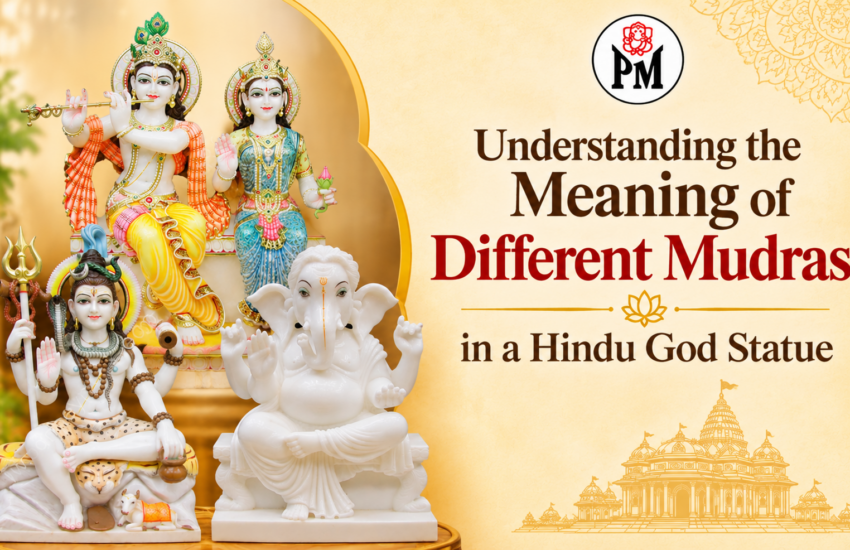
Every mudra, or hand gesture in a Hindu God statue, has a meaning. Even if you look closely at the idols in your home temple, you will notice that every deity has a different hand gesture. While some raise their hand as if giving blessings, others hold something in their palm or point their fingers towards the ground. Have you ever thought why?
In Shilpa Shastra, these hand gestures tell devotees a lot about blessings, protection, and qualities associated with the deity. Understanding these mudras makes daily prayers more meaningful while also helping devotees to choose the right idol for their home or temple.
Through this detailed guide, popular marble moorti maker Satya Narain Pandey, with a deep understanding of Hindu idols, explains the meaning behind different mudras in a Hindu God statue, the significance of each, and why they differ among Gods and Goddesses.
What are the Different Types of Mudras Seen in Hindu God Idols?
When you look at a Hindu God statue, their hands can tell a lot about the form they represent. In Hindu iconography, a mudra is particularly described as a hand or finger position, which may express meditation, generosity, reassurance, and knowledge sharing.
However, it is worth noting that the hand gestures are only part of the representation. A deity’s posture, expression, and the symbols they hold have importance, too. So, let’s understand the six common mudras of Gods & Goddesses idols mentioned in Shilpa Shastra.
Abhaya Mudra
Abhaya is a Sanskrit word which means “without fear,” or “fearless.” This mudra of deities often demonstrates them in a fearless form, with one hand raised and the palm facing outwards while fingers point upward.
The Abhaya mudra is a sign for devotees that they do not need to live in fear. This hand gesture is common in many religious and artistic representations, including some forms of Lord Vishnu and Shiva Statues.
Varada Mudra
Varada is another Sanskrit word that translates to “giver of boons, or “granting blessings.” The mudra is often depicted with a deity’s palm held outward and fingers pointing downward. The five fingers in the mudra represent paramitas: generosity, morality, patience, perseverance, and meditative focus.
There is a noticeable difference between Varada and Abhaya mudra in a Hindu God statue. While the raised palm of the deity in Abhaya is usually associated with reassurance, the lowered hand in Varada is traditionally linked with giving away.
Dhyana Mudra
Dhyan mudra refers to a hand gesture associated with meditation and deep concentration. The hands rest in the lap, with one placed over the other. In some representations, the thumbs are joined together to form a triangle.
This mudra is usually associated with stillness, peace, and meditation. It creates a serene appearance in many meditative figures, such as Adiyogi and Lord Buddha. The mudra reminds of the importance of self-peace and spiritual growth.
Jnana Mudra
Jnana Mudra, also called the gesture of knowledge, is commonly recognized by the thumb and index finger touching to form a circle. The other three fingers remain straight and extended. The mudra is associated with knowledge, awareness, and understanding in a relevant yogic context.
This hand gesture is usually seen in depictions of meditating figures. However, its meaning depends on how the hand is positioned and the tradition it belongs to. For example, Jnana Mudra is usually shown with the palm facing upward, while a similar gesture with the palm facing downward is known to be as Chin Mudra. While both relate to meditation and concentration, they are understood differently in some traditions.
Anjali Mudra
Anjali Mudra is one of the most familiar hand gestures in marble God idols, with both palms joined together, usually in front of the chest. You may recognize it as “Namaste,’ a greeting used in many Indian families.
In religious art, the joined hands are an expression of respect and prayer. The gesture is common in representations of devotees, attendants, and divine figures.
Vitarka Mudra
Vitarka mudra is usually linked to teaching, discussion, and knowledge sharing in many traditions. The deity in this mudra is depicted as raising one hand with the thumb and index finger forming a circle.
This hand gesture is most common in Buddhist art. While similar hand gestures may be found elsewhere, they should not automatically be given the same meaning. The deity, the direction, and the wider artistic context also matter when interpreting a hand gesture.
How Do Mudras Differ Among Hindu Gods and Goddesses?
Not all Hindu deities have a common mudra or hold their hands in the same way. As said, the hand gestures are only part of how each form of God or Goddess is represented, alongside posture, expression, and traditional attributes.
For instance, a raised palm in Abhaya mudra expresses reassurance, while a down-facing open palm in Varada Mudra is linked to granting blessings.
Let’s consider a few familiar examples to understand the different mudras in Hindu deities:
- Lord Shiva Statue: Some forms of Mahadev depict the Lord with one raised hand associated with reassurance, while other forms may show him in deep meditation. The traits of Lord Shiva are usually shown through these mudras.
- Lord Vishnu Murti: Lord Vishnu’s four-armed form depicts Him with multiple hand gestures and holding objects such as a discus and the conch. These symbolic objects add to the meaning of the representation, but it is important to note that they are not mudras.
- Lord Ganesha Idol: Ganesha’s statues often combine blessing gestures with objects such as a goad, a noose, or a sweet. However, the depiction of the murti depends on the particular form.
- Goddess Lakshmi Murti: Most of the representations show Mata Lakshmi with a blessing gesture and a hand in a giving position. At the same time, symbolic elements such as the lotus contribute to her iconographic identity.
These are just examples of different mudras and postures rather than fixed rules for every idol. The same deity can be represented in different forms according to traditional practices.
Do Mudras Influence the Meaning and Significance of a God Murti?
Yes, mudras do contribute to the overall meaning of a God murti, but it is also important to note that they do not tell the whole story. A hand gesture may communicate the traits associated with the deity, while the posture, facial expression, and symbolic objects they hold provide further context.
Two statues of the same deity may look different if they represent different forms or follow different iconography traditions. For instance, a Mahadev statue is depicted in meditative, blessing or even dancing form.
This becomes even more important to understand when buying marble idols or comparing different postures. A family may prefer a particular form because it is familiar and meaningful to them. Knowing these traditional symbolisms helps them appreciate the details instead of judging the idols solely on an appearance basis.
From my personal perspective as a moortikar, hand positions are the most important part of shaping the deity’s form. The fingers, arm, palm, and the overall hand posture should complement each other to create the intended representation.
While an artisan can easily recognize these details and their common meanings, devotees may find it a little difficult to understand what each hand gesture represents. Therefore, a mudra should be understood in proper context. And it is noteworthy that no single gesture automatically makes an idol more powerful or auspicious, and no particular hand gesture guarantees success or prosperity.
Conclusion
The next time you look at a marble God statue, notice how the hands, fingers, and posture come together to shape its expression. These small yet noticeable details are what make each murti distinct from others and help preserve the traditional art of moorti making. Understanding the different mudras also helps devotees appreciate the idol-making skills and thoughts involved in the process.
If you’re looking for traditionally crafted marble God idols for your home or temple, explore the handcrafted marble murtis at Pandey Moorti Bhandar, where we combine our four generations of experience with traditional artistry and skilled craftsmanship to create each idol.
FAQs
What Do the Different Mudras Mean?
Each mudra in Hindu God idols has different spiritual meaning related to reassurance, blessings, meditation, knowledge, respect, and teaching. However, the exact meaning greatly depends on the hand position, the deity, and the artistic and religious tradition.
What is the Most Common Mudra in a Hindu God Statue?
Abhaya and Varada mudras are two of the most common and recognizable gestures in Shilpa Shastra. However, it is difficult to find one that is the most common across all regions and traditions.
Why Do Some Hindu God Statues Have Multiple Hands?
Multiple hands are a traditional representation of many Hindu deities. Each hand shows different divine qualities, symbolic functions, and attributes at once. The hand gestures and the symbolic elements held in each hand represent the deity’s particular form.
Which Mudra is Considered Auspicious for Idols Kept at Home?
There is no single mudra that is considered auspicious or inauspicious for home worship. The appropriate mudra and form depend on the deity, family tradition, and devotional preferences.
Which Mudra Represents Meditation and Inner Peace?
Dhyana mudra is commonly associated with meditation, deep concentration, and contemplation. The hands usually rest on the lap, with one hand placed over the other. However, the exact position may vary across different religious traditions.