
 Posted by
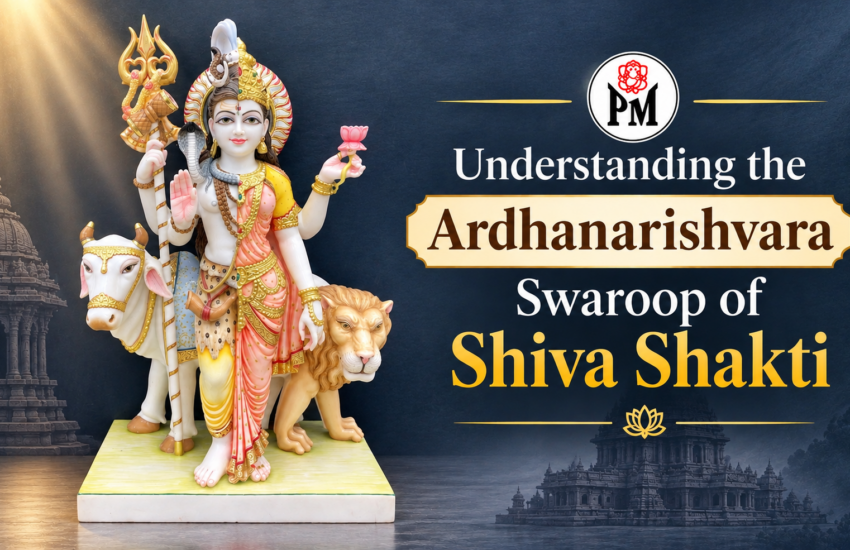
The Ardhanarishvara Swaroop of Lord Shiva and Goddess Parvati depicts them together as one deity, where one half represents masculine strength and the second half shows feminine energies. This form of Shiva and Shakti is a divine unity of consciousness and energy.
For devotees, Ardhanarishvara represents the unity of two divine powers and explains how both Shiva and Shakti are essential to the universe. Every detail in this form has a deeper spiritual meaning.
But what is the story behind this unique form? What does each half of this form signify? Let us understand its origin, religious significance and symbolism through Hindu beliefs and traditional iconography.
The Origin of Ardhanarishvara: How Did Shiva and Shakti Become One?
As said, Ardhanarishvara is a combined form of Lord Shiva and Goddess Parvati, where both deities share one body. The meaning of the term “Ardhanarishvara” is derived from three Sanskrit words. For instance, Ardha, which means half; Nari, which means woman; and Ishvara, which translates to Lord. Together, the name means the Lord who is half-woman.
The origin of this divine form is described in different Hindu religious sculptures and traditions. While one commonly discussed story is associated with the creation of the universe, another belongs to Rishi Bhringi and his devotion to Lord Shiva.
According to the Skanda Purana, Lord Brahma needed the power of creation to continue the process of existence of living beings on this earth. When He approached Lord Shiva for help, Shiva manifested Himself in a combined male and female form. At Lord Brahma’s request, Lord Shiva separated Shakti from His body, and then the Goddess blessed Brahma with the power to create female beings and continue the process of creation.
Meanwhile, another well-known account involves a story of Sage Bhringi, a devoted follower of Lord Shiva. According to Amar Charitra, the story narrates that the sage only wanted to worship Lord Shiva and refused to acknowledge Goddess Parvati. To make him realize that Shiva and Shakti are inseparable, Lord Shiva and Goddess Parvati manifested the Ardhanarishvara form. Even then, the sage Bhringi took the form of a bee to pass between the male half of the divine body.
What Does Ardhanarishvara Murti Symbolize?
The Ardhanarishvara idol has several meanings behind it. First of all, its physical appearance brings together Shiva and Parvati. Secondly, it closely relates to the nature of existence and the relationship between consciousness and energy.
The two halves of the murti have their own distinct identities, yet neither is depicted as completely separate from the other. Here’s what the Ardhanarishvara idol symbolizes:
The Union of Masculine and Feminine Energies
The most common meaning we can understand of the Ardhanarishvara form is the divine union of masculine and feminine energies. The right half represents Lord Shiva, and the left half represents Mata Parvati, who is also referred to as Shakti.
As Shiva is traditionally associated wth consciousness and stillness, Shakti represents the energy of movement and creation. And their combined form expresses the belief that these two aspects can never be separated.
The Balance Between Purusha and Prakriti
Another philosophical interpretation of Ardhanarishvara Swaroop can be understood through the concepts of Purusha (consciousness) and Prakriti (nature). In a broader sense, Purusha can be understood as the witnessing principle, and Prakriti is associated with the processes of existence.
The form shows the devotees how consciousness and the active principle of nature are complementary aspects of existence. The understanding is important for devotees to know that the Ardhanarishvara form represents more than two physical halves.
The Interdependence of Shiva and Shakti
In many Hindu traditions, Shiva and Shakti are understood as one rather than two completely different independent powers. The form explains that neither exists in isolation from the other. This divine union shows that the creation and existence depend on the presence of both.
The Ardhanarishvara statue also reflects the belief that the feminine and masculine principles are dependent on each other and that neither can be understood in complete isolation from the other.
Harmony, Completeness and Cosmic Creation
Ardhanarishvara form of Lord Shiva and Mata Parvati represents completeness and presents both deities as part of one whole.
The form has been described in art and religious studies as a representation of divine completeness. The masculine and feminine aspects are not competing for importance but completing each other.
The symbolism behind Ardhanarishvara murti is broader than a simple message of balance. It reminds us that different aspects of existence can retain their own unique identities while belonging to a larger whole.
How to Worship Ardhanarishvara at Home?
The worship of Ardhanarishvara Swaroop is no different from worshipping the Shiva-Parvati statue. Sincere intentions and devotion are more important than following formal, elaborate rituals. But make sure that the worship practices are respectful and honour both deities.
Here’s how you can worship Ardhanarishvara murti at home:
Preparing a Clean and Suitable Place
Always choose a clean and peaceful area to place the murti. Keep the surroundings neat and make sure there is enough space for family members to offer prayers comfortably.
If your home already has a dedicated place for worship, you can place the Ardhanarishvara murti there according to your household customs.
Placing the Ardhanarishvara Murti
It is important that you place the idol respectfully on an elevated platform that can support its weight properly. Do not place the statue directly on the floor, as it is a sign of disrespect. Also, make sure it is placed securely and protected from accidental falls or damage.
Always choose the size of the statue according to the available space and the arrangement of your home temple. Families may follow their own traditions when deciding its placement.
Traditional Offerings
After placing the murti, make it your daily habit to offer flowers, fresh water, fruit, incense and a diya during worship. You can also include other offerings according to your regional customs.
These are some familiar devotional offerings rather than a mandatory list of items every devotee must offer. You can follow your family’s practices.
Chanting Prayers and Mantras
Devotees can chant Shiva mantras or prayers associated with Goddess Parvati. You can also follow prayers specifically dedicated to Ardhanarishvara.
If you wish to chant a particular Sanskrit mantra, make sure to check its wording and traditional associations with a priest instead of relying on unverified online instructions.
Following Family Traditions
Worship practices can differ from custom to custom, and there is no way to assume that every family follows a fixed ritual.
It is always better to follow your traditional prayers and offerings according to your ability and devotional practices. If your family follows a specific ritual tradition, consult a knowledgeable priest for its prescribed procedures.
Conclusion
Ardhanarishvara murti has a special place in Hindu religious art as it combines both feminine and masculine energies in one body. Its mythology, philosophical interpretations and physical features each have a meaning and spiritual significance.
As a traditional marble moorti manufacturer, I also appreciate the craftsmanship required to create such a divine murti while maintaining the individual identity of both halves. At Pandey Moorti Bhandar, we value these traditional details while making marble Shiv Parivar murti.
FAQs
Why is Lord Shiva Depicted as Half a Woman?
Lord Shiva is depicted as half a woman and half a man in his Ardhanarishvara Swaroop with Goddess Parvati as his inseparable part. Together, they represent Shiva and Shakti. The form reminds devotees that masculine and feminine principles are equally important and that both balance existence.
Which Side of Ardhanarishvara Represents Goddess Parvati?
In most representations, Goddess Parvati represents the left side of the Ardhanarishvara form, while the right side belongs to Lord Shiva. The hairstyle, clothing, ornaments and physical features help distinguish the two sides.
Which Direction Should Ardhanarishvara Murti Face?
There is no universally accepted or mandatory direction where Ardhanarishvara murti should face. Every family has their own worship custom and placement preferences. However, many traditions believe a deity idol should face West or East. Devotees can also follow the guidance of their family priest when deciding the placement.
Where is the Famous Ardhanarishvara Temple Located?
The most popular Ardhanarishvara Temple is Ardhanareeswarar Temple, which is located on a hill in Tiruchengode, Namakkal district, Tamil Nadu. The deity is worshipped as Shiva and Shakti in one combined form. The temple is considered an important Shaiva pilgrimage centre in the Kongu region.
What is the Relationship Between Shiva and Shakti?
Shiva and Shakti can be understood as interconnected divine principles in many popular Hindu traditions. While Lord Shiva is traditionally associated with supreme divine principles, Shakti represents the power and its active expression. The understanding of their relationship is important to the Ardhanarishvara representation.