
 Posted by
Idol worship has a deep spiritual significance in Hinduism that serves as a way to connect devotees with their Lord. But before any new idol is placed in a temple, there is a series of sacred rituals that have to be followed, and the most important among them remains pran pratishtha. It is basically a consecration ceremony to invoke the divine presence in the idol and prepare it for worship according to Hindu traditions.
Like many Hindu rituals, there are many myths that surround this sacred ritual. While many believe it should be limited to temple idols, others argue that the same ritual is necessary for idols kept at home.
To help people understand the significance of pran pratishtha, marble moortikar Prashant Pandey, drawing from his experience in the art of moorti making, explains the meaning of this ritual, its religious significance, the rituals involved, and how consecration relates to idols installed in temples and homes.
What is Pran Pratishtha?
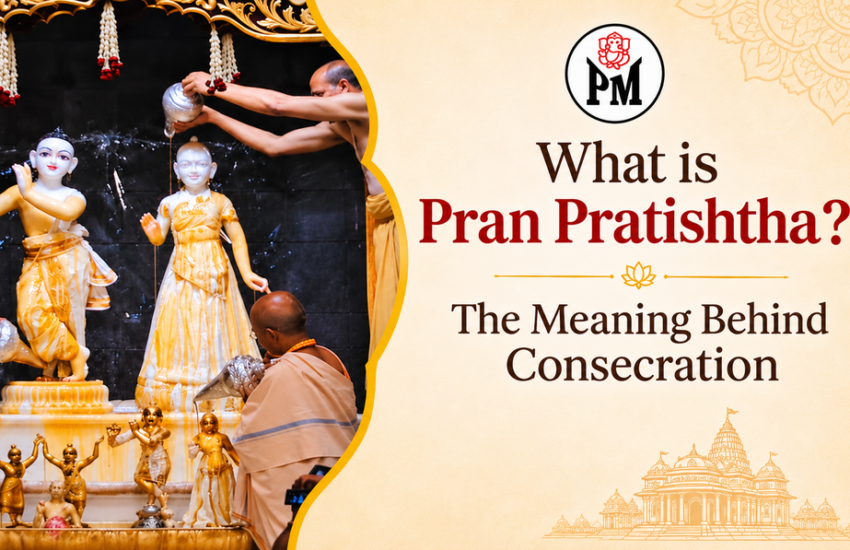
Pran Pratishtha is a traditional consecration ceremony in which the divine presence of a deity is invoked into an idol through Vedic rituals, mantras, and prayers. The word “Prana Pratishtha” is derived from two Sanskrit terms: “Prana,” which means life or vital breath, and “Pratishtha,” which refers to establishment. Together, the meaning of Prana Pratishtha describes a sacred ritual of establishing a deity’s life in an idol for worship. Once the God idol undergoes the appropriate ceremony, it is described as consecrated.
However, the precise customs followed during prana pratishstha may differ between traditions, temples, and regional practices. At the same time, the ritual is broadly classified into two main categories:
Chal Pran Pratishtha
The Sanskrit word “Chal” generally means movable. Therefore, Chal Pran Pratishtha refers to meaning of consecration associated with idols intended to be moved or carried. This type of prana pratsishtha is well-suited for home idols, ceremonial processions and festive (utsav) murtis. The ritual is different from that required for an idol in a fixed temple setting.
However, that doesn’t mean every idol kept in a home automatically requires a formal Chal Pran Pratishtha ceremony. For instance, festival idols such as a Ganpati idol during Ganesh Chathurthi or Mata Durga murti during Navratri don’t require any formal ceremony before being welcomed at home. It is important to know that devotees’ pure intentions matter more than any formal ritual or arrangements.
Achal Pran Pratishtha
The word ‘Achal’ generally refers to something that is immovable. In a similar sense, Achal Pran Pratishtha is associated with the formal consecration ceremony for idols intended to remain in their designated sacred spaces, especially in temples.
Achal Pran Pratistha is an elaborate ceremonial practice that involves extensive preparations and prescribes rituals conducted according to the temple’s religious traditions.
The Pran Pratistha process starts with establishing the deity’s idol in the designated worship area, followed by a series of sacred rituals, prayers, and Vedic mantras to invoke the divine presence and prepare the idol for regular worship.
Is Pran Pratishtha Necessary for All Idols?
No, the same formal Pran Pratishtha is not necessarily for every idol. It greatly depends on where the idol will be placed, how the murti will be used, the kind of worship intended, and the religious customs followed by temples or families.
For temples, the deity’s idol is formally consecrated according to prescribed traditions and may require several preparatory and principal rites.
But home worship is little different. The idols do not require a formal consecration. For instance, families can bring home the murtis of Ganesh Ji, Radha Krishna, or another deity and start their daily prayers according to family customs.
It is important to understand that an idol does not lose all devotional significance only because a formal consecration has not taken place. Devotees can still pray before the idol as an expression of faith, gratitude, and personal connection with the deity.
How is Pran Pratishtha Done?
Pran Pratishtha is an important religious ceremony, and it should be performed carefully. However, the exact procedure of Pran Pratishtha depends on the deity, installation place, and the specific customs being followed.
In a formal installation, the preparations start before the principal ceremony. The idol and the designated place are made ready, and the arrangements are completed as per specific customs. The ceremony typically involves purification rites, worship of the deity, the recitation of traditional mantras, and the principal consecration rituals.
However, these practices should not be taken as a checklist. Every part of the procedure has a meaningful tradition that guides the ceremony. The priest performing the ritual follows the procedures appropriate to that installation rather than following one universal method for all idols.
What Happens After Pran Pratishtha?
Once the Pran Pratishtha ceremony is concluded, the idol becomes as divine as the deity. In the relevant Hindu traditions, the ceremony establishes the murti’s religious role and the devotional practices that follow.
In temples, the consecrated deity idols are meant for public worship. The temple institution may assign duties for daily offerings, prayers, and ceremonial observances to those responsible.
At home, the practice may differ a bit. Some families perform daily aarti, while others may follow simpler routines based on their family customs. There is no rule that every household must maintain the same schedule as large temples.
A consecrated idol should be treated with respect, and devotees must understand the special requirements associated with its installation. If a permanently installed temple idol needs to be moved, repaired, or replaced, it is important to seek guidance from a priest or someone familiar with the relevant tradition. At the same time, it is important to understand that a devotee’s intentions always matter more than any formal ritual.
Conclusion
Pran Pratishtha is an important ritual in Hindu traditions as it marks the dedication of an idol to the deity and the worship associated with that installation. Understand its meaning is also crucial to understand where it is actually require and where not.
Families should not take these customs with fear or confusion. They should follow their established practices or seek guidance from a knowledgeable priest. At Pandey moorti Bhandar, we bring a deep understanding of such sacred rituals and traditional craftsmanship to every creation, preserving the devotion and heritage behind each moorti.
FAQs
Can a Non-Brahmin Do Pran Pratishtha?
Pran Pratishtha traditionally involves specific Vedic mantras, sacred rituals, and scriptural knowledge. This is why many families prefer Brahmin priests who have studied the Vedas and learned the procedures required for such ceremonies.
Can We Do Pran Pratishtha at Home?
Yes, you can perform Chal Pran Pratishtha at home. However, regular household worship does not necessarily need a formal pran pratishtha. Families can follow their traditional customs.
How to Do Pran Pratishtha at Home?
Start by deciding on the place where you will keep the idol. For regular prayers, you can follow your family’s established customs for consecration. For formal Pran Pratishtha, seek guidance from a knowledgeable priest to understand the procedure and carry out the ceremony.
What is Consecration in Hinduism?
Consecration meaning in Hinduism refers to a ritual of invoking the living energy of a deity into the idol and establishing its role in worship according to the relevant tradition.
When Was the Ayodhya Ram Mandir Pran Pratishtha Ceremony?
The Pran Pratishtha ceremony of Shri Ramlalla at the Ram Mandir Ayodhya took place on 22 January 2024. The ceremony was attended by Prime Minister Narendra Modi and representatives of religious traditions from across India. It was the consecration ceremony for Ram Laal (the child form of Lord Rama).